

HVAC Executive Compensation Report 2025
Originally published: April 2026 | Reviewed by Rob Cohlan
HVAC executives earned between $83,340 and $379,962 annually in 2025, with compensation determined by role title, company revenue tier, and ownership structure.
General Managers at private equity-backed HVAC firms earn a median base salary between $173,400 and $231,092. VP of Operations roles command a national median of $236,903.
Private equity ownership delivers a 30 to 50 percent total compensation premium over equivalent roles at independently owned HVAC operators.
Executives benchmarking an offer, candidates negotiating a package, and hiring managers setting salary bands will find role-by-role figures below drawn from Glassdoor, PayScale, ZipRecruiter, Raw Selection, and ServiceTitan salary data current through Q4 2025.
Key Takeaways
- HVAC General Managers at PE-backed firms earn a median base of $173,400 to $231,092, scaling with company revenue tier, per a 2025 Raw Selection survey of 73 GMs and Presidents at PE-backed HVAC service companies.
- HVAC VP of Operations roles command a national median of $236,903, with 90th-percentile earners exceeding $433,000, per Glassdoor VP of Operations salary data compiled from 998 self-reported salaries as of November 2025.
- HVAC Regional Vice Presidents of Operations earn a national average of $282,315, with the 75th percentile at $379,962 and the 90th percentile reaching $489,491, per Glassdoor Regional VP Operations data as of November 2025.
- HVAC Service Managers earn a national average of $83,340 per PayScale’s 2025 HVAC Service Manager report. HVAC Operations Managers earn $148,492 in total compensation, according to Glassdoor’s 2025 HVAC Operations Manager dataset.
- Private equity acquirers model a GM replacement cost of $130,000 to $200,000 for HVAC firms generating $5M to $7M in annual revenue — a figure PE buyers use to restate EBITDA during acquisition due diligence.
What Do HVAC Executives Earn in 2025? National Salary Benchmarks by Role
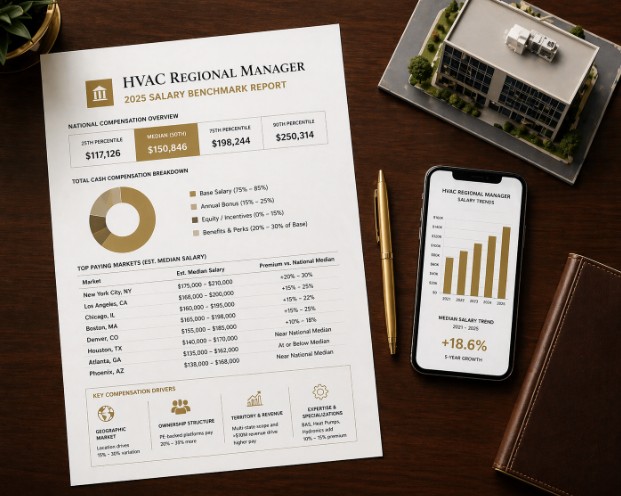
HVAC executive base salaries range from $83,340 for Service Managers to $282,315 for Regional Vice Presidents of Operations, based on data from Glassdoor, PayScale, ZipRecruiter, and Raw Selection current through Q4 2025.
The widest pay gaps exist between field-facing management roles and corporate leadership titles carrying full P&L accountability.
| Role | National Median (Base) | Total Comp Range | Source |
| HVAC Service Manager | $83,340 | $67,000 – $116,500 | PayScale / ZipRecruiter 2025 |
| HVAC Operations Manager | $98,981 | $115,087 – $194,995 | Glassdoor 2025 |
| HVAC General Manager (independent firm) | $122,500 | $100,000 – $155,000 | Talent.com 2025 |
| HVAC General Manager (PE-backed) | $173,400 – $231,092 | Up to $360,000 total comp | Raw Selection Survey 2025 |
| VP of Operations | $236,903 | $177,677 – $330,291 | Glassdoor Nov 2025 |
| Regional VP of Operations | $282,315 | $213,998 – $379,962 | Glassdoor Nov 2025 |
Glassdoor’s HVAC Operations Manager salary dataset reports a national total compensation of $148,492 for that role, with the 25th percentile at $115,087 and the 75th percentile at $194,995.
HVAC VP of Operations professionals earning at the 90th percentile exceed $433,000 in total compensation when annual bonuses are included.
HVAC Service Managers serve as the entry point on the executive pay ladder. PayScale’s 2025 HVAC Service Manager report records the national average at $83,340, a figure that understates earning potential in high-density commercial markets.
A General Manager title in the HVAC industry signals full profit-and-loss ownership and a scope of accountability that commands a material premium over the base salaries of Service Manager and Operations Manager roles.
Private equity acquirers model a replacement hire for an owner-operator function set that sets the replacement cost at $130,000 to $200,000 — the figure that defines the genuine market rate for a GM seat, regardless of what an incumbent earns.
Candidates targeting roles at these salary tiers can browse open HVAC executive positions at Alexander Associates Executive Search, LLC, or submit a resume to get matched with active confidential searches.
How Does Company Size Affect HVAC Executive Compensation?

Company annual revenue is the strongest single predictor of compensation for HVAC General Managers and Presidents at private equity-backed firms.
A 2025 Raw Selection survey of 73 General Managers and Presidents at PE-backed HVAC service companies measured base salary, bonus, and equity participation across three revenue tiers.
HVAC GM median base salary climbs from $173,400 at firms generating $10M to $30M in revenue to $231,092 at firms generating above $30M. Equity participation rate rises from under 20 percent at sub-$10M firms to 48 percent at firms with revenue above $ 30 M.
| Revenue Band | Median Base Salary | Equity Participation Rate | Total Comp Ceiling |
| Under $10M | $130,000 – $155,000 | Under 20% | $200,000 |
| $10M – $30M | $173,400 | 20–35% | $280,000 |
| Above $30M | $231,092 | Up to 48% | $360,000 |
Independent HVAC operators pay substantially less for an equivalent General Manager scope. HVAC General Manager salary database records the national average at $122,500, with entry-level GM roles starting at $100,000 and experienced GMs reaching $155,000.
The $155,000 ceiling at an independent operator often serves as the floor at a PE-backed firm managing comparable revenue — so executives weighing both offer types should model total compensation, not base salary alone.
HVAC executives evaluating competing offers from PE-backed and independent employers need to assess bonus potential, equity vesting schedule, and the company’s revenue growth trajectory, as well as base salary.
Alexander Associates’ multi-hire search discount program supports employers building complete leadership teams across Service Manager, Operations Manager, and GM levels simultaneously.
Employers with immediate openings can initiate a search through the job order submission page.
Regional Pay Gaps: Where HVAC Executives Earn the Most
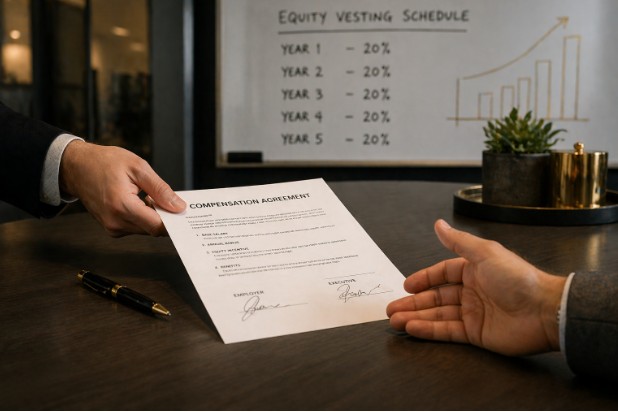
U.S. geographic market determines HVAC executive pay at every seniority level, with high-commercial-density states paying a premium of 20 to 30 percent above the national median for equivalent leadership roles.
States with large commercial building portfolios, strong union presence, active retrofit pipelines, and elevated cost-of-living costs generate the highest executive compensation floors.
The U.S. Bureau of Labor Statistics Occupational Employment and Wage Statistics program documents an annual pay gap of approximately $25,000 between the highest- and lowest-paying states for field-level HVAC roles, per BLS OEWS data published in May 2024.
That geographic pay differential widens at the General Manager, VP, and Regional VP levels, where total compensation includes location-sensitive bonus targets and cost-of-living adjustments.
Payscale’s 2024–2025 Salary Budget Survey, drawing on submissions from 1,550 organizations, identifies New Jersey (4.04 percent growth), California (3.97 percent), and Illinois (3.92 percent) as the three fastest-rising markets for HVAC base salary growth since June 2024 — three states where executive-level roles carry a 20 to 30 percent premium over national median pay.
| Regio | Executive Pay Premium vs. National Median | Primary Driver |
| Northeast (NY, NJ, MA, CT) | 20–30% above | Dense commercial building stock; union wage floors |
| West Coast (CA, WA, OR) | 15–25% above | High cost of living; energy retrofit demand |
| Mountain West (CO, UT, AZ) | 10–20% above | Fast population growth; new construction volume |
| Southeast (FL, GA, NC, TX) | At or below the national median | Lower cost of living offsets demand growth |
| Midwest (OH, IN, MI) | 5–10% below | Slower wage inflation; traditional industrial base |
Glassdoor’s Regional VP Operations compensation data, compiled from 14 self-reported salaries as of November 2025, shows that Regional Vice Presidents of Operations in Northeast and West Coast markets consistently fall within the $330,000 to $489,491 compensation band — at or above the 75th to 90th national percentile for the role.
Denver-area HVAC executive compensation warrants specific attention. Colorado’s population growth rate sustains above-median compensation for HVAC Service Directors, Regional Operations Managers, and VP-level hires, driven by sustained new construction volume and commercial retrofit demand.
The U.S. Census Bureau’s 2024 population estimates rank Colorado among the 10 fastest-growing states by numeric population growth — a demographic trend that directly sustains demand for commercial HVAC construction and services.
Candidates evaluating specific metro markets can review active HVAC career openings across Alexander Associates’ national search portfolio and view current candidate profiles to benchmark competing candidate packages.
Bonus and Equity Structures in HVAC Executive Compensation
HVAC executive base salary represents only a portion of total compensation. Bonus programs and equity participation structures determine whether a $175,000 base salary produces a $220,000 or $360,000 total compensation package — a $140,000 gap driven entirely by variable pay design.
Bonus Structures
The 2025 Raw Selection GM and President salary report surveying 73 PE-backed HVAC executives records that the majority of General Managers and Presidents across all revenue bands receive annual bonuses equal to 50 percent or less of their base salary.
A General Manager earning a $200,000 base at a typical PE-backed HVAC firm targets a total cash compensation package between $200,000 and $300,000 annually.
Bonus leverage increases at the VP and Regional VP levels. Glassdoor’s VP of Operations compensation dataset records a median additional variable pay of $49,511 annually for VP of Operations executives — a 20 percent bonus-to-base ratio at the median.
VP Operations executives at the 90th percentile generate total compensation above $400,000 when performance bonuses are included.
Equity and Profit Interest
A profits interest unit is a form of equity compensation issued by PE-backed HVAC holding companies that entitles the executive to a share of value created above a defined threshold at exit.
A management incentive unit (MIU) is a similar instrument used by private equity sponsors to align HVAC platform executives with fund return targets.
The Raw Selection survey records equity participation reaching 48 percent among GMs at firms with revenue above $30 million — meaning nearly half of senior HVAC executives at larger PE platforms hold some form of equity in their operating company.
General Managers joining PE-backed HVAC platforms at the pre-exit stage capture the highest equity upside, so the timing of entry relative to the sponsor’s hold period materially affects total wealth-creation potential.
Independent HVAC operators rarely offer equity instruments to non-owner executives. An equity offer from an independent operator typically signals a founder-led succession event or a recapitalization, rather than a standard compensation structure.
Alexander Associates’ staffing firm overview explains how executive search strategies differ between PE-backed and independent HVAC clients, so candidates can calibrate expectations before engaging.
Executives with specific package questions can review the HVAC executive recruiter FAQs for guidance on how compensation benchmarking works in a structured search process.
PE-Backed vs. Independent HVAC Companies: The Compensation Delta
Private equity acquisition of U.S. HVAC service companies restructured executive compensation benchmarks across the industry between 2018 and 2025. The base salary gap between PE-backed and independent HVAC employers now ranges from $50,000 to $110,000 for equivalent General Manager scope — a differential large enough to determine career trajectory decisions for senior HVAC executives.
Profitability Partners, a financial advisory firm that reviewed more than 200 HVAC and home services acquisitions, documents the mechanism directly driving this gap.
An owner-operator paying themselves $80,000 to manage a $7 million HVAC company creates an EBITDA overstatement of $70,000 to $120,000, because a professional General Manager replacement hire costs $150,000 to $200,000 in that revenue tier.
PE acquirers correct this overstatement during the Quality of Earnings process — and set the incoming GM’s salary at or near market replacement cost to prevent immediate retention risk.
| Role | Independent Operator Median | PE-Backed Median | Compensation Delta |
| General Manager | $122,500 | $173,400 – $231,092 | +$50,000 – $110,000 |
| VP of Operations | $200,000 – $220,000 (est.) | $236,903+ | +$20,000 – $50,000 |
| Regional VP of Operations | $230,000 – $250,000 (est.) | $282,315 | +$30,000 – $50,000 |
PE-backed HVAC positions offer equity participation and EBITDA-linked performance bonuses in addition to base salary, so executives joining a PE platform early in the hold period can double their total compensation at exit relative to an independent employer’s cash-only package.
HVAC executives evaluating C-suite and VP-level opportunities at PE-backed operators can apply for a position through Alexander Associates.
Employers benchmarking candidate packages against completed search outcomes can review professional recommendations from prior Alexander Associates engagements.
HVAC Executive Compensation Trends: 2024 vs. 2025
HVAC executive salaries increased across all major role categories in 2025, driven by three compounding forces: skilled-labor scarcity at the supervisory and management level, accelerating PE platform acquisition activity, and specialization premiums in heat pump, building automation, and energy conservation disciplines.
Payscale’s 2024–2025 Salary Budget Survey, drawing on compensation data from 1,550 organizations, records entry-level HVAC base salary growth of 3.44 percent nationally, senior technician salary growth of 3.62 percent, and HVAC supervisor pay growth of 3.53 percent year-over-year — with no projected salary decreases in any U.S. state.
Executive-level pay increases at PE-backed platform companies tracked above these technician-level rates because private equity sponsors allocate capital to growth-stage leadership hiring without the revenue constraints that limit independent operators’ compensation decisions.
Heat pump market expansion drove targeted hiring for Product Development Directors and VP of Sales roles in thermal systems and applied engineering throughout 2025.
The U.S. Department of Energy’s 2024 Heat Pump Market Report documents accelerating commercial heat pump adoption across U.S. building stock — a deployment trajectory that created immediate demand for executives with heat pump and hydronics engineering credentials.
HVAC executives carrying those specialization credentials earned a 10 to 15 percent base salary premium over generalist HVAC leaders in equivalent title brackets.
PE consolidation pressure created a supply-demand imbalance in the Regional VP and General Manager talent market throughout 2025.
The S&P Global Market Intelligence 2024 Private Equity Outlook identifies home services as one of the most actively acquired sectors in the U.S. lower middle market — a classification that includes residential and commercial HVAC service operators.
Dozens of PE-sponsored HVAC platforms competed simultaneously for a finite pool of experienced operators, pushing base salaries for regional leadership roles above what general compensation survey data captures. Employers and candidates navigating this market can explore how a specialist MEP recruiter delivers hiring advantages that a generalist staffing firm cannot replicate.
Building automation system (BAS) specialization produced the largest single-discipline compensation premium at the director and VP level in 2025.
The U.S. General Services Administration’s 2024 Building Automation Systems guidance defines a Building Automation System as an integrated network of hardware and software that monitors and controls a building’s mechanical, electrical, and HVAC systems — a technical discipline commanding a measurable pay premium over generalist HVAC credentials.
HVAC executives holding BAS, Building Management System (BMS), or energy conservation engineering certifications earn above-median compensation, particularly at large commercial service operators and PE-backed platforms targeting the commercial and industrial building segment.
The U.S. HVAC and climate control services market is projected to grow from $21.16 billion in 2025 to $29.13 billion by 2030, per Grand View Research’s HVAC Systems Market Report — a 37.6 percent expansion that will sustain upward compensation pressure across all executive tiers through the second half of the decade.
The U.S. Bureau of Labor Statistics Occupational Outlook Handbook projects HVAC mechanic and installer employment to grow 6 percent through 2032, faster than the average for all occupations — a labor demand trajectory that compounds executive talent scarcity at the supervisory and leadership levels.
Employers building leadership teams ahead of that growth curve can discuss HVAC professional hiring strategy and facilities management executive hiring with Alexander Associates Executive Search, LLC as part of a structured multi-role workforce plan.
Employers hiring across multiple leadership levels simultaneously can place a multi-role search request through Alexander Associates’ job order process.
Frequently Asked Questions
What is the average salary for an HVAC General Manager in 2025?
HVAC General Managers at independent firms earn a national average of $122,500 in 2025, according to Talent.com. At PE-backed companies, median base salary ranges from $173,400 to $231,092 across revenue tiers, with total compensation reaching $360,000 at firms above $30M in revenue, per the 2025 Raw Selection survey.
How much does a VP of Operations earn in the HVAC industry?
An HVAC VP of Operations earns a national median of $236,903 per year in 2025, based on 998 self-reported salaries compiled by Glassdoor as of November 2025. The 90th percentile for the role exceeds $433,000 when annual performance bonuses are included.
How do PE-backed HVAC companies pay compared to independent operators?
PE-backed HVAC companies pay General Managers $50,000 to $110,000 more annually than independent operators for equivalent P&L scope. Private equity acquirers set GM salary floors at market replacement cost — typically $130,000 to $200,000 at a $5M to $7M revenue firm — to correct EBITDA overstatement created by below-market owner-operator compensation.
What bonus structure is typical for HVAC executives in 2025?
HVAC General Managers and Presidents at PE-backed firms receive annual bonuses equal to 50 percent or less of base salary per the 2025 Raw Selection survey. VP-level executives carry a bonus-to-base ratio of 15 to 25 percent at the median, with higher variable pay leverage at larger revenue-platform companies where annual EBITDA targets drive bonus payouts.
Which U.S. regions pay the highest HVAC executive salaries?
The Northeast U.S. — specifically New York, New Jersey, Massachusetts, and Connecticut — and the West Coast states of California, Washington, and Oregon pay the highest HVAC executive salaries, running 20 to 30 percent and 15 to 25 percent above the national median, respectively. Colorado ranks as a high-growth compensation market driven by population growth and sustained commercial construction volume.
What is the salary for a Regional VP of Operations in HVAC?
HVAC Regional Vice Presidents of Operations earn a national average of $282,315 per year in 2025, with the 25th percentile at $213,998 and the 75th percentile at $379,962 per Glassdoor data from November 2025. Top earners at the 90th percentile report total compensation of $489,491.
Do HVAC executives receive equity at PE-backed companies?
HVAC General Managers at PE-backed firms above $30M in revenue hold equity instruments in 48 percent of cases per the 2025 Raw Selection survey. Equity below that revenue threshold applies to under 20 percent of GMs. Equity compensation in PE-backed HVAC firms typically takes the form of profit interest units or management incentive units (MIUs) that vest over 3 to 5 years and pay out upon a portfolio company sale.
How does company revenue affect HVAC GM pay?
HVAC General Manager’s base salary scales directly with the company revenue tier in PE-backed firms. GMs at sub-$10M revenue firms earn $130,000 to $155,000. GMs at firms above $30M earn a median base of $231,092 with total compensation reaching $360,000. Both the equity participation rate and the annual bonus intensity increase with each successive revenue tier.
What HVAC specializations command the highest executive salaries in 2025?
HVAC executives holding heat pump, hydronics, building automation system (BAS), or energy conservation engineering credentials earn 10 to 15 percent more than technically generalist leaders at equivalent seniority levels. BAS-specialized Vice Presidents and Directors command the largest premium at commercial service operators and PE-backed platforms targeting commercial and industrial building segments.
How do I find HVAC executive roles at PE-backed companies?
Alexander Associates Executive Search, LLC specializes in placing HVAC, MEP, and building services executives at PE-backed and independent operators across the United States. Candidates can submit a resume directly or browse current searches through the career opportunities page at HVACExec.com.