

The HVAC Executive Hiring Scorecard: How to Evaluate Leadership Beyond the Résumé
Originally published: September 2026 | Reviewed by Rob Cohlan
An HVAC executive hiring scorecard is a fixed set of evaluation dimensions, thresholds, and required evidence, built before candidate sourcing begins.
The scorecard replaces impression-based interviewing with evidence-based scoring, so hiring committees measure candidates against one standard rather than against each other.
Employers who build the scorecard before writing the job description interview against criteria that predict performance in a specific operating model, which HVACEXEC.com calibrates into every employer search.
Key Takeaways
- A scorecard defines evidence thresholds before sourcing begins, not evaluation criteria after résumés arrive.
- The highest-value dimensions measure scope of ownership, not tenure length or title seniority.
- Acquired growth and built growth require different leadership capabilities and score separately.
- Independent scoring against fixed criteria produces comparable candidates; unstructured interviews produce ranked impressions.
Mishired executives cost a full search cycle and the momentum an open leadership seat drains. HVACEXEC.com calibrates criteria before sourcing — start a search.
Why Does Résumé Review Fail for HVAC Executive Roles?
Résumé review fails at the executive level because HVAC titles carry no standardized scope. A General Manager at a single-branch residential contractor and a General Manager at a private equity-backed platform share a title and little else.
Three failure modes recur across senior mechanical services searches:
- Title inflation. A Director title at a 40-person contractor may carry narrower authority than a Branch Manager title at a national distributor.
- Unattributed results. Revenue growth appears without indicating whether the executive drove it or inherited it from a transaction closed above their level.
- Context collapse. Margin improvement achieved in a rising market and margin improvement achieved during a contraction read identically on paper.
Reading more carefully does not resolve any of the three. Employers resolve them by deciding in advance which evidence would distinguish the cases, then requesting that evidence directly.
The scale of the problem is not small: the U.S. Bureau of Labor Statistics projects 308,700 annual openings for general and operations managers between 2024 and 2034, more than any other occupation typically requiring a bachelor’s degree.
What Belongs on an HVAC Executive Hiring Scorecard?
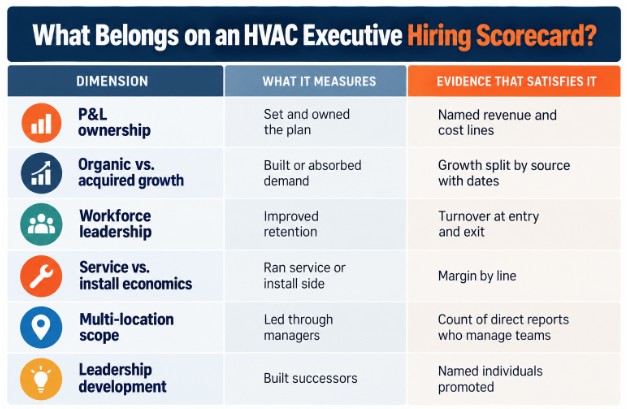
A usable scorecard covers ownership, operating environment, and people development. Each dimension needs a threshold specific enough that two interviewers scoring the same answer reach the same number.
The six dimensions below form HVACEXEC.com’s standing calibration set for mechanical services leadership searches.
| Dimension | What It Measures | Evidence That Satisfies It |
| P&L ownership | Whether the executive set the plan or executed another’s | Named revenue figure, cost lines owned, person the plan was defended to |
| Organic vs. acquired growth | Whether the executive built demand or absorbed it | Growth split by source, with acquisition dates |
| Workforce leadership | Whether retention improved under their direction | Turnover at entry and exit, plus the retention mechanism used |
| Service vs. install economics | Which side of the business the executive ran | Margin by line, and which line consumed their time |
| Multi-location scope | Whether the executive led through managers | Count of direct reports who themselves managed teams |
| Leadership development | Whether the executive built successors | Named individuals promoted, and into which roles |
Which dimensions a search actually needs depends on the operating model behind the role, and HVACEXEC.com weights them accordingly.
A distributor branch search weights vendor negotiation and inventory economics, while a commercial contractor search weights bid discipline and contract renewal.
The leadership profile by business model determines the weighting before you approach any candidate.
How Can Employers Verify P&L Ownership in an Interview?
Profit-and-loss responsibility is the single most misread claim on an HVAC executive résumé, because the phrase covers everything from full accountability to monthly report review.
Ownership becomes verifiable through sequence rather than assertion. An executive who genuinely owned a P&L describes how the annual plan was constructed, which assumptions were contested, who contested them, and what happened when performance diverged from plan.
HVACEXEC.com uses four probes to establish the distinction:
- Which line items the executive moved without approval, and which required sign-off.
- How the plan changed between first draft and final approval, and who forced the change.
- What happened the first month performance missed plan, and to whom the executive answered.
- Which costs the executive protected during a downturn, and what was cut instead.
Answers should contain specifics that could not be reconstructed from a job description. Vagueness at this depth is itself a finding, and the same principle governs technical screening further down the organization.
How Do Employers Separate Built Growth From Acquired Growth?
Consolidation across HVAC and home services means many senior candidates led businesses that grew substantially without those executives having generated the demand.
Both profiles carry value, but they are not interchangeable, and a scorecard scores them separately rather than collapsing both into one growth metric.
An employer expanding an existing branch network organically needs evidence of demand generation: pricing changes, service-agreement programs, technician capacity added ahead of revenue.
An employer integrating a recent transaction needs evidence of integration work, which the post-acquisition leadership search framework addresses in detail.
Asking a candidate to split their growth figure by source often settles the question in a single exchange.
Executives who built the growth typically answer with the mechanism, while executives who inherited it tend to answer with the total. HVACEXEC.com treats that split as a primary screening signal.
Hiring committees stalled between two strong-looking résumés have a criteria problem. HVACEXEC.com defines evidence thresholds before sourcing — request a calibration call.
Why Does Structured Scoring Produce Better Shortlists?
Structured scoring compares candidates against fixed thresholds. Unstructured interviewing produces a ranking of how much each interviewer liked each candidate, which is a different output and a weaker one when stakeholders disagree.
Federal selection standards shape the practice. The U.S. Equal Employment Opportunity Commission’s Uniform Guidelines on Employee Selection Procedures, adopted in 1978 and codified at 29 C.F.R. Part 1607, cover interviews alongside written tests.
Where a selection procedure produces adverse impact against a protected group, the Guidelines require the employer to show that the procedure is job-related and consistent with business necessity. Where no adverse impact exists, the Guidelines do not require validation.
Employers who document criteria and apply them consistently across a slate are better positioned to make that showing than employers relying on interview notes written from memory.
| Practice | Unstructured Approach | Scorecard Approach |
| When scoring happens | After the debrief discussion | During each interview, independently |
| What gets recorded | Overall impression, ranked | Dimension score plus the supporting evidence |
| How disagreement resolves | Loudest advocate prevails | Divergent scores expose an undefined threshold |
| Defensibility at review | Recollection weeks later | Written evidence attached to each dimension |
Executives at this level command real compensation, which raises the cost of a scoring error.
BLS reports a median annual wage of $126,520 for management occupations in May 2025, against $50,980 across all occupations, with roughly 1.1 million management openings projected annually through 2035.
When Should the Scorecard Be Built in the Search Timeline?
Build the scorecard before sourcing, not after résumés arrive. Building it afterward lets the criteria be shaped by whoever happened to apply, which works against the purpose.
HVACEXEC.com publishes an average search timeline of 30 to 60 days from job order to placement, and calibration sits at the front of that window rather than competing with it.
A search that begins with agreed criteria is less likely to stall midway while stakeholders discover they wanted different executives. Employers weighing whether to run the search internally can compare the tradeoffs through specialist recruiter engagement models.
The sequence runs: define the operating problem, derive the dimensions that predict success against it, set thresholds, then write the job description from those dimensions.
Completed searches across PE-backed platforms and facility services organizations follow the same order regardless of seniority.
Employers can review anonymized candidate profiles before committing to a search, and organizations filling several seats at once can review the multi-hire program.
Frequently Asked Questions
What is an HVAC executive hiring scorecard?
An HVAC executive hiring scorecard is a fixed set of evaluation dimensions with defined thresholds and required evidence, built before sourcing begins. The scorecard specifies what proof satisfies each standard, which separates it from an interview question list that only specifies what to ask.
How many dimensions should a scorecard contain?
HVACEXEC.com calibrates most executive searches to between five and eight dimensions. Fewer than five misses business-model-specific capabilities. More than eight produces scores interviewers cannot record reliably during a live conversation, which pushes scoring to afterward.
How can an employer verify genuine P&L ownership?
Ask the candidate to describe how they built the annual plan rather than what it contained. Executives who owned a profit-and-loss statement can name which assumptions were contested and by whom. Executives who reported against one recite figures without the negotiation behind them.
Should the scorecard come before or after the job description?
Before, write the job description from the scorecard dimensions so the posting names capabilities that predict success. Writing the description first usually produces generic requirements the scorecard must then work around, which weakens both documents and the resulting candidate slate.
Does a scorecard replace the interview?
No. The scorecard structures the interview by specifying what each conversation must establish. Interviewers still probe, follow up, and exercise judgment, but they do so against defined criteria rather than accumulating a general impression that resists comparison across a candidate slate.
How do scorecards differ between General Manager and C-suite searches?
General Manager scorecards weight direct operating control: margin, technician retention, daily execution. C-suite scorecards weight capital allocation, board or sponsor reporting, and development of the leadership layer beneath. Evidence standards tighten as scope widens because fewer executives have operated at the higher level.
Are structured hiring criteria a legal requirement?
Federal law does not mandate scorecards. The EEOC’s Uniform Guidelines require a showing of job-relatedness and business necessity where a selection procedure produces adverse impact, and do not require validation where no adverse impact exists. Documented criteria support that showing.
What should a hiring committee do when two finalists score similarly?
HVACEXEC.com treats a near-tie as a signal of an omitted dimension rather than an evenly matched field. Identifying the capability the role actually depends on, then scoring that dimension specifically, separates candidates more reliably than adding interview rounds.
Who should score candidates during an executive search?
Everyone who interviews scores independently, before debrief discussion. Scores recorded after a group conversation drift toward the loudest opinion in the room. Independent scoring preserves genuine disagreement, which signals that a dimension needs sharper definition or further evidence.
Bottom Line
An HVAC executive scorecard converts hiring from impression to evidence. It names the dimensions that predict success in a specific operating environment, sets thresholds for each, and specifies what proof satisfies them.
The dimensions that matter most measure scope of ownership, not seniority of title. Employers who define those thresholds before sourcing interview against a standard, while employers who define them afterward interview against whoever arrived.
Empty leadership seats drain margin every month they stay open. Rob Cohlan builds the criteria before candidates are approached — submit a job order to begin.