

What Makes a Great HVAC General Manager? How the Leadership Profile Changes by Business Model
Originally published: September 2026 | Updated: October 2026

A great HVAC General Manager profile is not one-size-fits-all: the skills, KPI focus, and reporting structure that make a GM successful differ sharply across residential home services companies, commercial mechanical contractors, equipment distributors, manufacturers’ representatives, and private equity-backed platforms.
Residential GMs need sales culture and technician-retention skills; commercial GMs need bid discipline and contract-renewal experience; distributor and manufacturer GMs need supply-chain and product-cycle fluency; PE-backed GMs need scorecard-driven, owner-independent operating discipline.
Matching the profile to the business model reduces mis-hires and shortens ramp time.
Key Takeaways
- Residential home services GMs get evaluated primarily on sales culture, sales coaching, technician retention, and maintenance agreement growth.
- Commercial mechanical contractor GMs get evaluated primarily on bid discipline, service contract renewal, and project margin control.
- Distributor and manufacturers’ representative GMs get evaluated primarily on supply chain management, vendor relationships, and product cycle execution.
- Private equity-backed platform GMs get evaluated primarily on EBITDA performance, scorecard metrics, and the ability to operate without owner dependency.
Hiring the wrong GM profile drives costly turnover and stalled momentum. HVACEXEC.com builds a scorecard matched to the exact business model before the search begins.
What Changes in the GM Role Across HVAC Business Models?
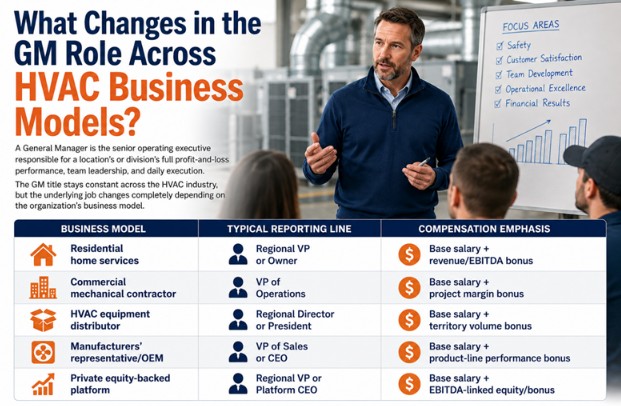
A General Manager is the senior operating executive responsible for a location’s or division’s full profit-and-loss performance, team leadership, and daily execution.
The GM title stays constant across the HVAC industry, but the underlying job changes completely depending on the organization’s business model.
A residential home services company measures a GM against sales conversion and technician headcount. A commercial mechanical contractor measures a GM’s performance against bid win rate and contract retention.
Employers who write a single generic GM job description end up interviewing candidates who cannot perform the actual role.
| Business Model | Typical Reporting Line | Compensation Emphasis |
| Residential home services | Regional VP or Owner | Base salary + revenue/EBITDA bonus |
| Commercial mechanical contractor | VP of Operations | Base salary + project margin bonus |
| HVAC equipment distributor | Regional Director or President | Base salary + territory volume bonus |
| Manufacturers’ representative/OEM | VP of Sales or CEO | Base salary + product-line performance bonus |
| Private equity-backed platform | Regional VP or Platform CEO | Base salary + EBITDA-linked equity/bonus |
Reporting line and bonus design are the visible differences. The constraints that quietly disqualify otherwise strong candidates — licensing scope, season, union status, line conflicts, earn-out authority — are covered in five conditions that stall mechanical services searches before the first interview.
What Does a Great GM Look Like at a Residential Home Services Company?
In HVACEXEC.com’s recruiting experience, a residential home services GM answers first for sales culture, sales coaching, technician retention, and maintenance agreement growth.
The strongest candidates come from a call-center-driven, comfort club style operating environment where lead conversion and average ticket size determine branch performance.
A GM who cannot build and coach a sales-minded service team will underperform in this model regardless of technical background.
HVACEXEC.com’s regional VP search for a home services platform targeted exactly this profile: a candidate with direct P&L ownership, a proven maintenance-agreement build, and demonstrated technician-retention results across multiple branches.
Residential GM candidates also need fluency in field service management platforms, flat-rate pricebooks, and on-call rotation structures.
Employers evaluating this profile should weight interview time toward sales team development and technician retention over pure technical depth, since the branch’s technicians already carry the technical execution.
What Does a Great GM Look Like at a Commercial Mechanical Contractor?
Based on HVACEXEC.com’s search experience, a commercial mechanical contractor GM answers first for bid discipline, service-contract renewal, and project margin control.
This profile requires comfort with longer sales cycles, account concentration risk, and the working-capital demands that come with progress billing and retainage on large jobs.
HVACEXEC.com’s HVAC service director search for a Denver mechanical contractor and SVP mechanical services search for a facility services organization both targeted leaders with mission-critical account experience across healthcare, data center, and institutional service contracts.
Commercial GM candidates should demonstrate a track record of renewing service agreements, controlling install-phase costs, and coordinating with estimating and project management teams.
In HVACEXEC.com’s experience, candidates strong in residential sales culture often struggle in this environment, since commercial buyers respond to technical credibility and contract terms rather than call-center conversion tactics.
What Does a Great GM Look Like at an HVAC Equipment Distributor?
A distributor GM answers first for supply-chain management, vendor relationships, and territory-level volume growth. This profile spends more time on inventory turns, freight and logistics coordination, and manufacturer-line performance than on direct field labor management.
HVACEXEC.com’s general manager search for a New York metro heat transfer OEM targeted a candidate who had already managed multi-line distribution relationships and could defend margin against national account pricing pressure.
Based on HVACEXEC.com’s placements in this segment, distributor GMs also need direct experience negotiating with manufacturer sales representatives and managing counter and outside sales teams simultaneously — a skill set that residential and commercial contractor GMs rarely develop.
What Does a Great GM Look Like at a Manufacturers’ Representative or OEM Organization?
A manufacturers’ representative or OEM GM answers first for product-cycle execution, cross-functional coordination with engineering, and channel-partner performance.
HVACEXEC.com’s general manager search for a heat pump manufacturer in Canada targeted a candidate who could run daily operations while also guiding product launch timing and evaluating new market opportunities alongside engineering leadership.
This profile differs from the other business models covered here because the GM often carries direct accountability for product development milestones, not just sales and service execution.
Employers hiring this profile should prioritize candidates with manufacturing or engineering-adjacent leadership experience over pure field-service backgrounds.
What Does a Great GM Look Like at a Private Equity-Backed HVAC Platform?
In HVACEXEC.com’s experience placing PE-backed leadership, this profile requires the most formal operating discipline of the five business models covered here.
CEO searches for a PE-backed home services platform and chief growth officer searches both target candidates who have already operated inside a sponsor-owned structure and understand board reporting cadence.
Based on the sponsor-backed searches HVACEXEC.com has run, a PE-backed GM commonly reports against monthly KPI packages, defends variance to plan, and manages multi-location P&L visibility.
In HVACEXEC.com’s experience, a candidate who has only run a single owner-operated branch often needs a transitional step before stepping into this seat.
How Should Employers Screen and Evaluate GM Candidates Across These Profiles?
Employers should build the interview scorecard around the specific business model before writing the job posting, not after receiving resumes.
A well-written GM job description that names the correct KPIs upfront filters out mismatched applicants before the first phone screen.
HVACEXEC.com’s framework for hiring a facilities management executive recommends using a director-level title rather than “manager” or “coordinator” for these searches, since title language alone changes which candidates apply.
| Business Model | Highest-Risk Failure Point | Key Screening Signal |
| Residential home services | GM cannot build a sales-driven service culture | Documented maintenance-agreement or comfort-club growth |
| Commercial mechanical contractor | GM loses margin on progress-billed projects | Track record of service-contract renewal rates |
| HVAC equipment distributor | GM cannot defend margin against national accounts | Direct multi-line vendor negotiation experience |
| Manufacturers’ representative/OEM | GM misses product launch milestones | Prior cross-functional engineering coordination |
| Private equity-backed platform | GM cannot operate independently of the founder | Prior experience reporting to a board or sponsor |
A specialist MEP recruiter who already understands these distinctions can pre-filter the initial candidate slate against the correct scorecard rather than a generic leadership template, which HVACEXEC.com has found shortens search timelines in practice.
Hiring committees stalling between two strong-looking GM resumes usually have a scorecard problem, not a candidate problem. HVACEXEC.com reviews open GM searches against the business-model-specific criteria before presenting a shortlist.
Bottom Line
The GM title means five different jobs depending on the business model behind it.
Residential home services rewards sales-culture builders, commercial contracting rewards bid-and-contract discipline, distribution and manufacturing reward supply-chain and product-cycle fluency, and private equity platforms reward scorecard-driven, board-ready operators.
Employers who match the scorecard to the business model before the search starts consistently shorten time-to-fill and reduce first-year GM turnover.
Matching the profile to the business model is the first half of the work. Setting the evidence thresholds each dimension has to clear is the second, which is what an executive hiring scorecard built before sourcing begins is for.
Frequently Asked Questions
What is the biggest mistake employers make when hiring an HVAC General Manager?
Employers most often write one generic GM job description and apply it across every business model. A residential-focused description filters out the bid-discipline and contract-renewal experience a commercial mechanical contractor actually needs, producing mismatched candidate slates from the start.
Can a residential HVAC GM succeed at a commercial mechanical contractor?
Not usually without a transitional step, based on HVACEXEC.com’s placement experience. Commercial contracting rewards bid discipline, project margin control, and long sales cycles, while residential success depends on call-center conversion and technician retention. The skill sets overlap only partially.
What KPIs should a private equity-backed HVAC platform track for its GM?
EBITDA performance against the sponsor’s defined scorecard, variance-to-plan reporting accuracy, and the platform’s ability to absorb add-on acquisitions without disrupting existing branch operations are the KPIs HVACEXEC.com sees sponsors prioritize most often across the private equity-backed executive searches it has completed nationwide.
Does an HVAC equipment distributor GM need field service experience?
Direct field service experience helps but isn’t required. Distributor GMs need stronger skills in inventory management, manufacturer-line negotiation, and territory volume growth than in direct technician supervision.
How long does an HVAC General Manager executive search typically take?
Most leadership searches take six to twelve weeks from kickoff to acceptance, per HVACEXEC.com’s own placement data. Timing depends on location constraints, compensation alignment, and interview velocity. A calibrated scorecard and structured shortlist keep the timeline from stalling.
What title should employers use when posting a GM-level HVAC role?
A director-level or general manager title signals the correct seniority and filters out under-qualified applicants. Titles like “coordinator” or “manager” without qualification create a gray area that attracts too many junior-level applications.
Why does a manufacturer’s representative GM need engineering coordination skills?
This GM often carries direct accountability for product launch timelines, not just sales results. Coordinating with engineering on production launches and evaluating new product opportunities falls inside the role’s core responsibilities at this business model.
Should employers use a generalist recruiter or an HVAC-specific recruiter for a GM search?
An HVAC-specific recruiter already understands which KPIs matter for each business model and can pre-filter candidates against the correct scorecard. In HVACEXEC.com’s experience, generalist recruiters often need additional education on industry terminology and business-model distinctions before sourcing begins in earnest.
What soft skills matter most for an HVAC General Manager?
Collaboration, persistence, and the ability to coach a team through changing job conditions rank among the most important soft skills across every HVAC business model, though the specific application shifts with the operating environment.
How does compensation structure differ for HVAC GMs across business models?
Residential and commercial GMs typically earn a base salary plus a revenue, margin, or project-based bonus. Private equity-backed platform GMs often receive EBITDA-linked equity or bonus structures tied directly to the sponsor’s scorecard, based on HVACEXEC.com’s placements in these searches.
Building a GM scorecard from scratch takes weeks most employers do not have. Contact HVACEXEC.com to get a business-model-specific candidate slate built around the KPIs that actually predict success.
Related Resources for HVAC Employers