

HVAC Executive Recruiter vs. Staffing Agency: Which One Fits the Hire?
Originally published: November 2026 | Reviewed by Rob Cohlan
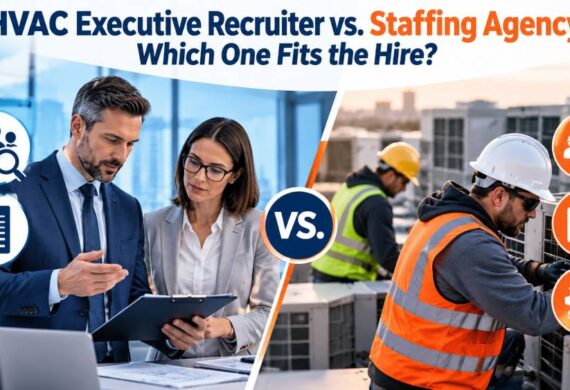
An HVAC staffing agency typically supplies technicians, installers, and other hourly workers from an available pool, often on temporary or temp-to-hire terms.
An HVAC executive recruiter is a search firm that typically finds leaders, such as general managers and regional VPs, through direct outreach.
The right choice depends on the role level, number of hires, candidate availability, and confidentiality needs.
HVACEXEC.com, an Aventura, Florida executive search firm for the mechanical services industry, runs employer leadership searches across five sectors, including distributors and manufacturers’ representatives.
Key Takeaways
- The Bureau of Labor Statistics projects about 40,600 openings a year nationally for HVAC mechanics and installers from 2025 to 2035.
- The Bureau of Labor Statistics lists 5 years or more of related work experience as typical for top executives across all industries.
- OSHA treats a staffing agency and its client as jointly responsible for a temporary worker’s safety on the job site.
- Each search under HVACEXEC’s Multi-Hire Fee Discount Program starts with a $2,500 payment, with the balance due within 30 days of placement.
An empty general manager seat leaves pricing, dispatch, and hiring decisions without an owner. HVACEXEC.com runs confidential executive searches; submit a job order today.
What Is the Difference Between an HVAC Executive Recruiter and a Staffing Agency?
A staffing agency usually fills hourly and field roles from available candidates, while an executive recruiter usually searches for leaders, many of whom already hold jobs. The two models differ in role level, sourcing method, assessment depth, and payment terms.
| Factor | Typical HVAC Staffing Agency | Typical HVAC Executive Recruiter |
| Typical roles | Technicians, installers, helpers, and seasonal labor | General managers, service directors, regional VPs, COOs and presidents |
| Candidate source | Mostly active job seekers and the agency’s worker pool | Mostly employed leaders reached through direct outreach |
| Employment relationship | Worker often stays on the agency’s payroll during a temp or temp-to-hire assignment | Hire joins the client’s payroll on the start date |
| Assessment depth | Varies by agency and role | Scorecard, structured interviews and KPI-based references |
| Payment model | Hourly bill rate for temporary workers, or a placement fee for direct hires | Retained fee paid in stages, or a contingency fee paid on hire |
| Visibility | Openings are usually advertised | Searches can run with no public posting |
The table describes typical models, not fixed boundaries. Many staffing agencies also run direct-hire searches for managers, and some executive recruiters fill technical specialist roles, so an employer should check each firm’s recent placements at the level being hired.
The case for a specialist MEP recruiter grows stronger as the seat gets more senior and the pool of qualified candidates shrinks.
Why Do Technician Hiring and Leadership Hiring Need Different Search Methods?
Technician hiring is a volume market with about 40,600 openings a year nationally, while leadership hiring draws on far fewer qualified people per role. National Bureau of Labor Statistics data for 2025 shows the gap in scale and entry requirements.
| Occupation (BLS, National) | Median Pay, May 2025 | Projected Growth, 2025 to 2035 | Common Requirement |
| HVAC mechanics and installers | $61,010 | 11% | EPA Section 608 certification to service refrigerant equipment |
| Top executives, all industries | $108,780 | 5% | 5 years or more of related work experience |
The BLS outlook for HVAC mechanics counts about 440,900 jobs in 2025, the number of employed workers, not the number of available candidates.
The BLS profile of top executives covers leaders across industries and notes that many are promoted from lower-level management within their own companies.
Those BLS figures describe national occupations, not the HVAC executive market itself. HVACEXEC.com’s professional observation, after more than 25 years of HVAC executive searches, is that most high-level HVAC executive roles are filled through confidential searches.
When Should an HVAC Company Use a Staffing Agency?
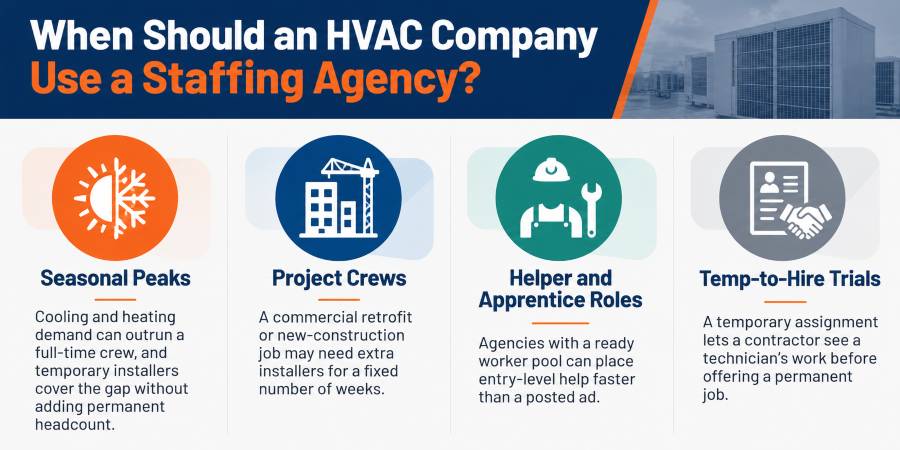
An HVAC company should use a staffing agency when it needs several field workers quickly, for a season or a single project, and can train them on site. Agencies also suit trial periods through temp-to-hire terms.
- Seasonal peaks: Cooling and heating demand can outrun a full-time crew, and temporary installers cover the gap without adding permanent headcount.
- Project crews: A commercial retrofit or new-construction job may need extra installers for a fixed number of weeks.
- Helper and apprentice roles: Agencies with a ready worker pool can place entry-level help faster than a posted ad.
- Temp-to-hire trials: A temporary assignment lets a contractor see a technician’s work before offering a permanent job.
Temporary placement brings shared legal duties. The OSHA temporary worker guidance makes the staffing agency and the host employer jointly responsible for a safe workplace, with the agency usually providing general safety training and the host training workers on its own equipment and site hazards.
The EEOC contingent worker guidance issued in 1997 treats the agency and its client as joint employers when both control the worker’s job, and it holds both to federal anti-discrimination law.
Contractors should confirm that every agency technician who will maintain, service, repair, or dispose of refrigerant equipment holds EPA Section 608 certification before starting work.
When Does an HVAC Leadership Hire Need an Executive Recruiter?
An HVAC leadership hire needs an executive recruiter when qualified candidates are hard to reach, the search should remain confidential, or the role requires deeper assessment than a credential check.
General managers, service directors, and regional VPs often meet all three conditions.
A published HVACEXEC search for an SVP of Mechanical Services at a national facility services provider covered five sectors and produced three finalists.
The hired executive came through peer recommendations from mechanical industry leaders, not inbound applications, and accepted the offer without late-stage renegotiation.
- The candidate pool is small: Qualified general managers and service directors are few in any one market, so the search has to reach them directly.
- The incumbent is still in the seat: Replacing a leader who has not left yet requires outreach without a public posting.
- The profile is sector-specific: A distributor branch leader and a contractor general manager share a title level but run different businesses.
- The role follows a deal: A platform making post-acquisition hires needs a leader matched to the operating gap the transaction created.
HVACEXEC.com works across residential home services, commercial and facilities firms, equipment distributors, manufacturers’ representatives, and original equipment manufacturers.
Its process runs in four steps: job order, deep-dive search, vetted short list, and placement with a replacement guarantee.
Posting a general manager search on job boards can alert competitors and staff. HVACEXEC.com keeps leadership searches confidential; start a confidential search now.
How Do Fees and Guarantees Compare Between a Staffing Agency and an Executive Recruiter?
Staffing agencies usually bill hourly for temporary workers or a one-time fee for direct hires, while executive recruiters charge a retained or contingency fee tied to the hire’s compensation. Guarantee terms differ by firm and should be in writing before work starts.
Retained vs. Contingency Search
Executive search fees are often set as a percentage of the hire’s first-year cash compensation or as a flat fee for defined deliverables.
With a contingency fee, the employer pays nothing if the search ends without a hire.
With a retained fee, you pay in stages, so part of the cost comes before any hire. For general manager and VP roles, HVACEXEC recommends retained search, which it describes as funding dedicated research, passive outreach, and deeper vetting.
The agreement should still name who works the search and what research is included.
Replacement Guarantees and Multi-Hire Terms
On a standard search, HVACEXEC runs a replacement search at no additional fee when a placed leader does not work out within the period set in the search agreement, which varies by seniority level.
Employers comparing staffing agencies should ask for their direct-hire replacement terms in the same written form.
Companies filling several leadership roles can use HVACEXEC’s Multi-Hire Fee Discount Program, which starts each search with a $2,500 payment and sets the balance due within 30 days of placement.
The program’s 90-day guarantee applies if the employer pays the balance on time and the hire leaves voluntarily or is terminated for cause.
HVACEXEC aims to source at least 50 pre-qualified candidate names with contact details per position under the program, a sourcing target that sets the depth of the long list.
Which Option Fits Common HVAC Hiring Scenarios?
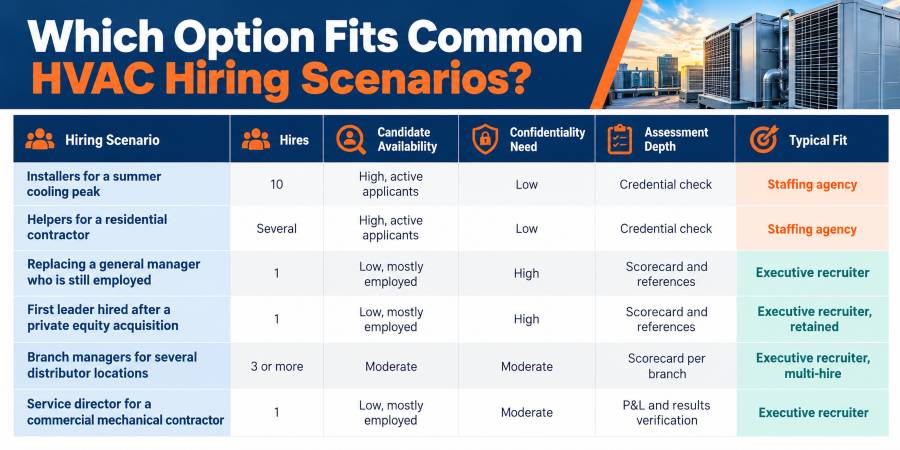
Four criteria decide the fit in most HVAC hiring scenarios: number of hires, candidate availability, confidentiality, and the depth of assessment the role needs. The table applies those criteria to six common situations, and the right leadership profile for each seat also shifts by business model.
| Hiring Scenario | Hires | Candidate Availability | Confidentiality Need | Assessment Depth | Typical Fit |
| Installers for a summer cooling peak | 10 | High, active applicants | Low | Credential check | Staffing agency |
| Helpers for a residential contractor | Several | High, active applicants | Low | Credential check | Staffing agency |
| Replacing a general manager who is still employed | 1 | Low, mostly employed | High | Scorecard and references | Executive recruiter |
| First leader hired after a private equity acquisition | 1 | Low, mostly employed | High | Scorecard and references | Executive recruiter, retained |
| Branch managers for several distributor locations | 3 or more | Moderate | Moderate | Scorecard per branch | Executive recruiter, multi-hire |
| Service director for a commercial mechanical contractor | 1 | Low, mostly employed | Moderate | P&L and results verification | Executive recruiter |
A regional VP search for a national home services company shows what deeper assessment looks like.
The client and HVACEXEC agreed on a fixed scorecard before the first candidate conversation, covering multi-market accountability, coaching cadence, field credibility, operating discipline, and culture fit.
Network-led outreach with no job posting produced seven qualified candidates, three finalists, and one accepted offer.
The table shows typical fits, and an agency with a strong direct-hire desk can still win a mid-level manager search.
What Should an Employer Ask Any HVAC Recruiter Before Signing?
An employer should ask any recruiter which roles it fills, how it finds candidates, what it charges, and what happens if the hire leaves early.
The answers show whether the firm works as a staffing agency, an executive recruiter, or a mix of both.
- Which role levels has the firm filled in the past 12 months, and in which HVAC sectors?
- Does the firm reach employed candidates directly, or rely on applicants and its own database?
- Is the fee retained, contingency, or hourly, and what does it cover?
- Is the search exclusive, and for how long?
- Which companies are off-limits, and does the firm agree not to recruit from the employer after the search?
- When a candidate the firm introduced is hired later, does a fee still apply, and for how long?
- How long does the replacement guarantee last, and which departures does it exclude?
- Will the search run confidentially, and who sees each candidate’s name?
Recruiters who answer these questions in writing make the comparison easy. Strong firms can also name the HVAC subspecialties they cover and show placement retention records, two tests that separate specialists from generalists.
Frequently Asked Questions
Can a staffing agency fill an HVAC general manager role?
A staffing agency can fill an HVAC general manager role when it runs a direct-hire desk with leadership placements in mechanical services. Before signing an agreement, employers should ask for recent general manager placements, the sourcing method used, and references from those hiring companies.
What if a staffing agency also offers executive search?
Employers should judge a staffing agency that also offers executive search by its leadership desk. Employers should ask who runs the search, how many leadership roles that team has filled recently, and whether it reaches employed candidates directly or relies on applicant databases.
Who pays the fee when an HVAC company uses a recruiter?
The employer pays the fee when an HVAC company hires through a recruiter or staffing agency. Most firms bill under a retained, contingency, or hourly model. The written agreement should include fee terms, payment timing, and replacement conditions before the search starts.
How do HVAC executive search fees work, and what is retained search?
HVAC executive search fees are usually a percentage of first-year cash compensation or a flat fee. In a retained search, the employer pays in stages for a dedicated search, while contingency fees are paid only when a candidate starts work.
What is a temp-to-hire HVAC placement?
A temp-to-hire HVAC placement starts a technician or installer on a staffing agency’s payroll for a trial period. The contractor can offer a permanent job at the end of the trial. The model lets an employer judge field work before committing to a full-time hire.
Who is responsible for a temporary HVAC technician’s safety?
Under OSHA guidance, the staffing agency and the host employer share responsibility for a temporary HVAC technician’s safety. The agency usually covers general safety training, and the host covers hazards specific to its equipment and job sites. Both duties should be included in the contract.
Can an HVAC company use a staffing agency and an executive recruiter together?
An HVAC company can use a staffing agency and an executive recruiter at the same time for different roles. A contractor might use an agency for seasonal installers while a recruiter searches for a general manager. Each firm covers the role level its model fits.
Can an HVAC executive search stay confidential?
An HVAC executive search can stay confidential through sourcing and early interviews. HVACEXEC.com sources candidates directly instead of posting job ads and shares candidate information only with consent. References are typically contacted late in the search, and only with the candidate’s approval.
What guarantee comes with an HVAC executive placement?
HVACEXEC.com runs a replacement search at no additional fee when a placed executive does not work out within the period set in the search agreement. Under the Multi-Hire Fee Discount Program, the 90-day guarantee requires on-time payment and covers voluntary departures and terminations for cause.
Bottom Line
A staffing agency typically fits volume, seasonal, and entry-level HVAC hiring, where candidates are available and credential checks are enough. An executive recruiter fits general manager, service director, and regional VP searches, where qualified candidates are hard to reach, and the role needs deeper assessment. Employers who weigh hires, candidate availability, confidentiality, and assessment depth, and who get fees and guarantees in writing, can compare firms on equal terms.
Unclear authority and mismatched expectations are common reasons HVAC leadership hires fail. HVACEXEC.com builds a scorecard before outreach; submit a job order today.