

The Hidden HVAC Executive Market: Why the Best Leadership Candidates May Never Apply to a Posted Job
Originally published: November 2026 | Reviewed by Rob Cohlan

The hidden HVAC executive market is the group of qualified leaders, such as general managers and service directors, who are employed, not applying, and reachable mainly through referrals or direct outreach.
Passive HVAC executive candidates make up much of that group, so an applicant pool shows an employer only part of the real market.
HVACEXEC.com, an Aventura, Florida executive search firm for the mechanical services industry, runs confidential leadership searches designed to reach candidates who do not respond to ads.
Key Takeaways
- In January 2026, workers in management occupations had a median tenure of 6.1 years with their current employer, compared with 4.1 years for all wage and salary workers.
- Unemployment in management occupations averaged 2.1% in 2025, about half the 4.3% rate for all workers 16 and older.
- A published HVACEXEC regional VP search produced seven qualified candidates, three finalists, and one accepted offer with no job posting.
- A published HVACEXEC SVP search drew finalists from five sectors, and the hired executive came through peer recommendations.
A thin applicant pool for a general manager role does not always mean leaders are missing. HVACEXEC.com reaches employed leaders; submit a job order today.
What Is the Hidden HVAC Executive Market?
The hidden HVAC executive market is the part of the leadership talent pool that a job posting cannot see. An employer filling one HVAC leadership role works through three overlapping stages, and only the first one shows up on its own.
| Stage | Who Is in It | How an Employer Reaches It | What It Tells the Employer |
| Applicant pool | People who saw the posting and applied | Job ads, job boards and the company careers page | Who is looking right now |
| Reachable candidate market | Employed leaders in the same and adjacent sectors who would take a confidential call | Referrals, industry networks and direct outreach | Who could be persuaded to move |
| Qualified candidate market | Leaders from either group above who match the scorecard for the role | Structured interviews, results-based references and a fixed scorecard | Who should be hired |
The stages overlap: a strong applicant can also be qualified, and the qualified market is a subset of everyone the search reaches.
In the SVP search described below, the brief required both cross-team leadership and sales-growth capability, so a reachable candidate with only one of the two did not count as qualified.
The reachable market also grows when the role allows leaders from outside HVAC, because adjacent sectors add employed candidates who are unlikely to search HVAC job boards.
Why Do Strong HVAC Leaders Rarely Apply to Job Postings?
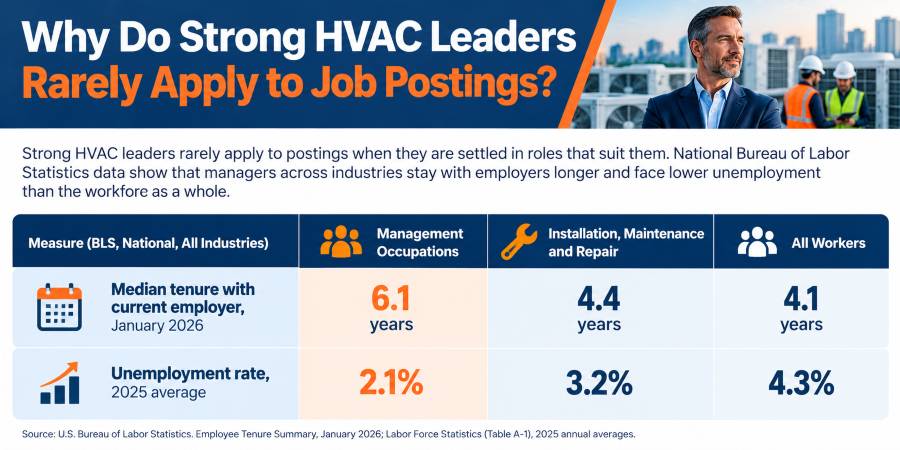
Strong HVAC leaders rarely apply to postings when they are settled in roles that suit them. National Bureau of Labor Statistics data show that managers across industries stay with employers longer and face lower unemployment than the workforce as a whole.
| Measure (BLS, National, All Industries) | Management Occupations | Installation, Maintenance and Repair | All Workers |
| Median tenure with current employer, January 2026 | 6.1 years | 4.4 years | 4.1 years |
| Unemployment rate, 2025 average | 2.1% | 3.2% | 4.3% |
The BLS employee tenure release for January 2026 found that management occupations had the longest median tenure within the management, professional, and related group, and its tenure by occupation table puts installation, maintenance, and repair workers at 4.4 years.
The BLS unemployment data by occupation puts the 2025 management rate at 2.1%, an 11-month average because the BLS did not collect October 2025 data.
BLS does not publish tenure or unemployment figures specifically for HVAC executives, so the management figures cover managers across industries.
Employed, passive, and unwilling are three different states. An employed leader may still be job hunting; a passive leader isn’t looking but would consider the right role; and an unwilling leader will not move on any terms the employer can offer, so only the first two respond to outreach.
HVACEXEC.com’s professional observation, after more than 25 years of HVAC executive searches, is that most high-level HVAC executive roles are filled through confidential searches.
The BLS profile of top executives also shows that many are promoted from lower-level management within their own companies.
Why Does a Weak Applicant Pool Not Always Mean a Weak Talent Market?
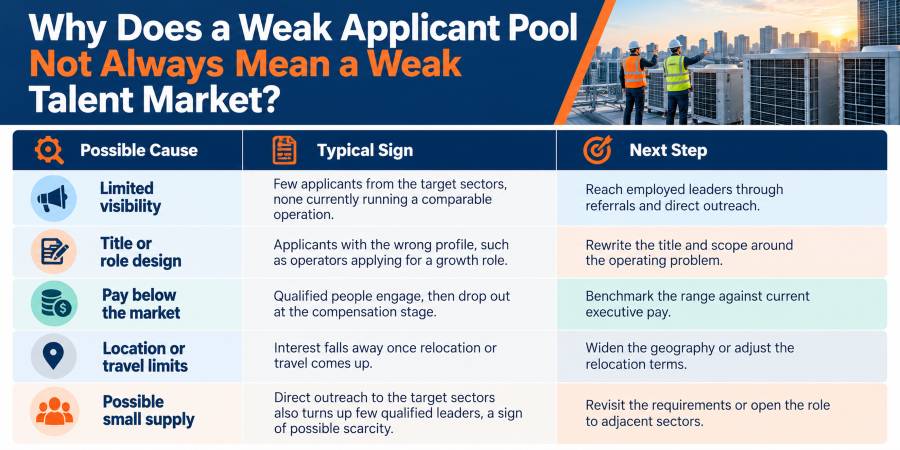
A weak applicant pool may mean the posting reached the wrong people, but it may also reflect pay, location, role design, or a small candidate supply. An employer should test each cause before deciding whether to rewrite the posting, change the role, or start a search.
| Possible Cause | Typical Sign | Next Step |
| Limited visibility | Few applicants from the target sectors, none currently running a comparable operation | Reach employed leaders through referrals and direct outreach |
| Title or role design | Applicants with the wrong profile, such as operators applying for a growth role | Rewrite the title and scope around the operating problem |
| Pay below the market | Qualified people engage, then drop out at the compensation stage | Benchmark the range against current executive pay |
| Location or travel limits | Interest falls away once relocation or travel comes up | Widen the geography or adjust the relocation terms |
| Possible small supply | Direct outreach to the target sectors also turns up few qualified leaders, a sign of possible scarcity | Revisit the requirements or open the role to adjacent sectors |
Employers who separate these causes avoid paying for a search that cannot succeed or giving up on a market they never reached.
A mismatched job title is a common place to start, because candidates often judge a role by its title before they read the description.
How Do Executive Recruiters Reach HVAC Leaders Who Are Not Looking?
Executive recruiters reach HVAC leaders who are not looking through industry referrals, peer recommendations, and direct outreach. Two published HVACEXEC case studies show how each search moved from first contact to an accepted offer.
| Search Stage | Regional VP Search, National Home Services Company | SVP of Mechanical Services Search, National Facility Services Provider |
| Starting point | A trusted industry referral | A brief requiring cross-team leadership and sales-growth capability |
| Sourcing | Network-led outreach with no job posting | Five sectors, from mechanical services firms to air moving equipment OEMs |
| Qualified candidates | Seven | Not reported |
| Finalists | Three | Three |
| Hire | One accepted offer, based on equity participation and the scope of national expansion | Hired through peer recommendations from mechanical industry leaders, with the offer accepted without late-stage renegotiation |
Neither hire came from candidates finding a posted opening. The outcomes above come from HVACEXEC’s two published case studies: the SVP search and the regional VP search, both of which started with a defined profile.
When an employer submits a job order to HVACEXEC, the process starts with a discovery call on the role, company culture, and ideal candidate profile. The search then moves through a deep-dive, a vetted shortlist, and placement with a replacement guarantee.
What Makes an Employed HVAC Leader Willing to Take a Confidential Call?
An employed HVAC leader is more likely to take a confidential call when the approach is discreet, matches the leader’s background, and ties to a larger role. The regional VP hire accepted the offer based on equity participation and the scope of national expansion.
- Discretion from the first contact: HVACEXEC shares a candidate’s resume or contact information with an employer only with the candidate’s explicit consent.
- A genuine fit: HVACEXEC contacts passively looking candidates only when a role fits their background.
- A clear step up in scope: Equity, P&L ownership, or a larger territory gives a settled leader a reason to weigh a move.
- Pay that matches the market: An offer below current HVAC executive compensation ranges gives an employed leader an easy reason to stay put.
A resigning leader may also receive a counteroffer. HVACEXEC’s analysis of accepting a counteroffer finds that a raise fixes pay but not reasons such as management, advancement, or workload, so the role’s scope matters as much as salary.
How Can an Employer Prepare a Confidential Search for Passive Candidates?
An employer prepares a confidential search by finalizing the role, pay, and decision process before outreach begins. HVACEXEC names location constraints, compensation alignment, and interview pace as the factors that affect a leadership search’s timing.
- Define the scorecard: In the regional VP search, the client and HVACEXEC agreed on a fixed scorecard covering multi-market accountability, coaching cadence, field credibility, operating discipline, and culture fit before the first candidate conversation.
- Set the scope and pay range: HVACEXEC starts a search with the role’s P&L scope, team size, territory, target KPIs, non-negotiables such as relocation and travel, and the compensation range.
- Settle authority: HVACEXEC lists unclear authority and mismatched expectations as common reasons HVAC leadership hires fail, so the role’s decision rights should be in writing before the first call.
- Plan the interview pace: HVACEXEC’s executive search FAQs note that confidential searches work best when the client gives fast feedback and holds a clear scorecard.
- Protect references until late: References are typically contacted late in the process and only with the candidate’s approval.
The right profile also depends on the business model, and a general manager profile for a distributor differs from one for a residential contractor. Employers who settle that profile first give every confidential call a clear purpose.
Frequently Asked Questions
What is a passive candidate in HVAC executive search?
A passive candidate is an employed HVAC leader who is not applying for jobs but would consider the right role. Recruiters usually reach general managers, service directors, and regional VPs in this group through referrals, industry networks, and direct outreach rather than job postings.
How can an employer tell whether an HVAC candidate shortage is real?
An employer can test a candidate shortage by directly reaching out to leaders in the target sectors. If direct outreach also yields few qualified people, the shortage may be real, and the requirements or sector range may need to change.
How long do managers usually stay with one employer?
In January 2026, workers in management occupations had a median tenure of 6.1 years with their current employer, according to the Bureau of Labor Statistics. The median for all wage and salary workers was 4.1 years, so managers move less often than most workers.
Why do employed HVAC leaders avoid applying to posted jobs?
Employed HVAC leaders often avoid posted jobs because applying publicly risks the current employer finding out. Many settled HVAC leaders also don’t read job boards, so a direct, confidential approach reaches them in a way a posting doesn’t.
What does a recruiter need before approaching passive candidates?
A recruiter needs the role’s P&L scope, team size, territory, target KPIs, non-negotiables (like relocation or travel), the compensation range, and the company culture. Settling those details before outreach lets the first confidential call answer the questions a settled leader will ask.
Does posting a job hurt a confidential HVAC leadership search?
A public posting can undermine a confidential HVAC leadership search by exposing the opening to staff, competitors, and the market. HVACEXEC runs confidential searches through direct sourcing instead of job ads, controls the messaging, and limits who learns about the opening.
Who pays for an HVAC executive search?
The employer pays for an HVAC executive search, not the candidate. HVACEXEC’s services are free to candidates, and the hiring company pays the fee. The written search agreement sets fee terms, payment timing, and replacement conditions before outreach to candidates begins.
When are a passive candidate’s references contacted?
Recruiters typically contact a passive candidate’s references late in an HVAC executive search, and only with the candidate’s approval. Waiting protects the candidate’s current job while the search is still open and the outcome is uncertain. Employers should schedule reference checks near the end.
Bottom Line
The hidden HVAC executive market consists of employed leaders who rarely see or respond to a posting. A weak applicant pool can reflect visibility, role design, pay, location, or possible scarcity, and each cause has a different fix. Employers who set the scorecard, pay range, and decision process before outreach give passive candidates a reason to take the call.
A strong general manager is already running someone else’s branch. HVACEXEC.com makes the confidential approach for employers; submit a job order to get started.