

When Should an HVAC Company Hire an Executive From Outside the Industry?
Originally published: September 2026 | Reviewed by Rob Cohlan

Hiring an executive from outside HVAC can work well for transferable functions like finance or marketing, but it carries real risk for roles that need hands-on technical judgment or field credibility.
The deciding factor is what the role’s success actually depends on, not whether the candidate came from inside or outside the trade.
Employers who evaluate that with HVACEXEC.com before opening the search can avoid defaulting to “industry experience required” for roles where it isn’t the deciding factor.
Key Takeaways
- Field-facing roles — technician management, code compliance, bid scoping — generally need direct HVAC or MEP experience.
- Function-first roles — finance, marketing, HR, general growth strategy — can work well with executives from adjacent industries.
- The most transferable skills are P&L ownership, multi-location management, and experience scaling a similar operating model.
- Employers should screen adjacent-industry candidates specifically for technical-vocabulary ramp-up and field credibility, not just general leadership ability.
Widening the candidate pool to adjacent industries opens strong options for the right roles and real risk for the wrong ones. HVACEXEC.com can help post the open role once that distinction is clear.
Which HVAC Leadership Roles Require Deep Industry Experience?
Roles where the executive needs to earn credibility with technicians, make technical judgment calls, or navigate code and licensing requirements generally need direct HVAC or MEP background.
A Service Director who has to resolve a technician’s callback dispute, or a GM who has to evaluate whether a bid underestimates refrigerant line complexity, draws on pattern recognition that takes years to build inside the trade.
Field technicians who handle refrigerant themselves are bound by federal certification requirements under the Clean Air Act, and a technical leader overseeing that work benefits from firsthand familiarity with what the job actually involves.
HVACEXEC.com’s facilities management search notes that most managers and directors specifically within facilities management are expected to hold certain professional certifications.
Other technical HVAC leadership roles — Service Director, Technical GM, VP of Operations — follow a similar pattern based on HVACEXEC.com’s placement experience, which narrows the realistic candidate pool to people already inside or adjacent to the trade.
Which HVAC Leadership Roles Can Work Well With an Outside-Industry Executive?
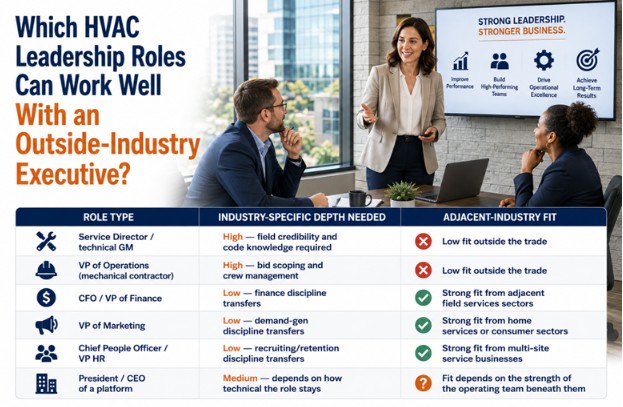
Roles built on a transferable management discipline — finance, marketing, HR, technology — can work well with an executive who has never worked in HVAC, provided the surrounding team carries the technical depth.
The federal Occupational Outlook Handbook confirms that most general and operations managers hired from outside an organization need supervisory or management experience in a related field.
| Role Type | Industry-Specific Depth Needed | Adjacent-Industry Fit |
| Service Director / technical GM | High — field credibility and code knowledge required | Low fit outside the trade |
| VP of Operations (mechanical contractor) | High — bid scoping and crew management | Low fit outside the trade |
| CFO / VP of Finance | Low — finance discipline transfers | Strong fit from adjacent field services sectors |
| VP of Marketing | Low — demand-gen discipline transfers | Strong fit from home services or consumer sectors |
| Chief People Officer / VP HR | Low — recruiting/retention discipline transfers | Strong fit from multi-site service businesses |
| President / CEO of a platform | Medium — depends on how technical the role stays | Fit depends on the strength of the operating team beneath them |
What Transferable Skills Matter Most When Hiring From Adjacent Industries?
The strongest adjacent-industry candidates come from businesses with a similar operating shape to HVAC, even when the trade itself is different — plumbing, electrical, pest control, landscaping, and other fragmented, multi-location field service sectors.
What transfers well: P&L ownership at the branch or regional level, experience managing a field-labor workforce, and a track record scaling operations through acquisition or organic growth.
The U.S. Department of Labor’s O*NET database organizes occupations partly around this kind of cross-functional skill, a useful reference point when mapping a candidate’s background onto an HVAC role.
The outside-hire test. HVACEXEC.com evaluates adjacent-industry candidates against three questions:
- Does the role require the executive to personally make technical or code-related judgment calls, or can the surrounding team absorb that?
- Has the candidate managed a field-labor workforce before, even in a different trade?
- Does the candidate have direct P&L ownership experience at a similar scale and location count?
A CFO candidate from a multi-location plumbing platform, with direct P&L ownership and no personal responsibility for technical judgment calls, tends to pass this test cleanly.
A general manager candidate from an unrelated, non-field-service industry — strong on paper but with no field-labor experience and full personal authority over technical bids — tends to fail it.
HVACEXEC.com’s soft-skills framework for MEP hiring covers a related evaluation discipline that applies just as well to executive candidates as it does to field hires.
What Are the Risks of Hiring an Executive Without HVAC Experience?
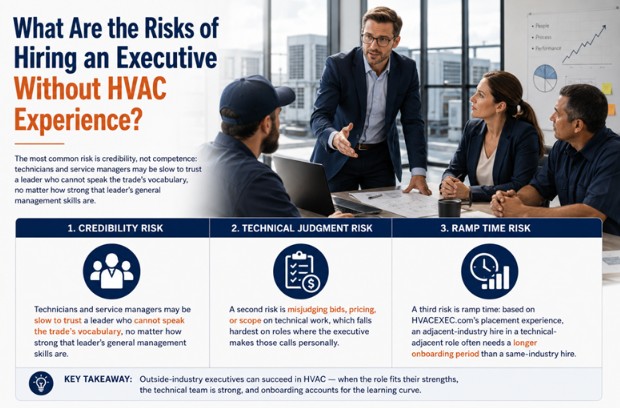
The most common risk is credibility, not competence: technicians and service managers may be slow to trust a leader who cannot speak the trade’s vocabulary, no matter how strong that leader’s general management skills are.
A second risk is misjudging bids, pricing, or scope on technical work, which falls hardest on roles where the executive makes those calls personally.
A third risk is ramp time: based on HVACEXEC.com’s placement experience, an adjacent-industry hire in a technical-adjacent role often needs a longer onboarding period than a same-industry hire.
HVACEXEC.com’s guide to choosing the right recruiter makes a related point: a recruiter unfamiliar with the trade has the same credibility gap employers should watch for in a candidate.
Employers should write job descriptions to reflect which of the credibility, technical-judgment, or ramp-time risks above actually apply to the specific role, rather than defaulting to “5+ years HVAC experience required” for positions where that requirement screens out otherwise strong candidates.
How Should Employers Structure the Interview Process to Test for Transferable Fit?
Employers evaluating an adjacent-industry candidate should weight the interview toward scenario-based technical questions rather than resume review alone.
The EEOC’s guidance on selection procedures states that evaluation criteria should be job-related and consistent with business necessity—a general principle that supports fair, defensible criteria for comparing HVAC-native and adjacent-industry candidates, though the approach below reflects HVACEXEC.com’s practice rather than an EEOC-endorsed method.
Pairing the candidate with a technical deputy for part of the interview, and asking them to walk through a real anonymized bid or field dispute, reveals more about readiness than a standard leadership interview.
| Adjacent Background | Best-Fit HVAC Role | Key Gap to Screen For |
| Plumbing/electrical field services executive | GM, Regional Executive, VP Operations | HVAC-specific code and equipment knowledge |
| Consumer/retail marketing executive | VP of Marketing | Understanding of long sales cycles for commercial HVAC |
| Multi-site healthcare or retail operations executive | President, Regional Executive | Field-labor workforce management specifics |
| Corporate finance executive (no field services background) | CFO, VP Finance | Familiarity with job-costing and service-agreement revenue models |
| General corporate HR executive | Chief People Officer | Recruiting for a blue-collar, licensed, mobile workforce |
HVACEXEC.com’s staffing-firm overview recommends structured interviews and KPI-based references as standard practice across every search HVACEXEC.com runs, technical or functional.
When Does Hiring Outside the Industry Make the Most Sense?
Hiring outside the industry makes the most sense when the business already has strong technical leadership in place — a seasoned service manager, a technically credible operations lead — and the open role is specifically a functional gap.
HVACEXEC.com has run CEO searches for PE-backed platforms, and Chief Growth Officer searches at organizations where this exact structure applied.
It makes the least sense when the open role is the only technical authority in the business, since no one else can catch a costly technical misjudgment during the new executive’s ramp-up period.
HVACEXEC.com’s about-us page and candidate profile listings reflect the range of both HVAC-native and adjacent-industry professionals the firm places across these role types.
Bottom Line
The deciding factor is technical bench strength, not just role title: hiring outside the industry works well when strong trade knowledge already exists elsewhere on the team, and carries the most risk when the incoming executive would be the only technical authority in the business.
Field-facing, code-dependent roles still generally call for direct HVAC or MEP background.
Finance, marketing, HR, and general leadership roles can work well with strong adjacent-industry candidates once that bench-strength condition is met.
Frequently Asked Questions
Can a CFO from outside the HVAC industry succeed in an HVAC company? Yes, particularly if that CFO has finance experience in a similar multi-location, field-service business model. The finance discipline transfers well across industries; the main gap to screen for is familiarity with job-costing and how HVAC companies recognize revenue from service agreements.
Is HVAC experience required for a VP of Marketing role? Not typically. Marketing and demand-generation skills transfer well across industries, and a strong marketing executive from a home services or consumer field-service sector can often perform well at an HVAC company without direct HVAC experience or trade certifications.
Why does a Service Director role usually need direct industry experience? A Service Director regularly makes technical judgment calls, resolves field escalations, and needs credibility with technicians who can tell quickly whether a leader understands the trade. Those requirements are difficult to build without years of hands-on HVAC or MEP field experience.
What HVAC leadership roles carry the highest risk when filled from outside the industry? Roles where the executive is the only technical authority in the business—a standalone GM or Service Director with no technical deputy on the team—carry the highest risk, since a costly technical misjudgment during onboarding has no one else to catch it.
Do plumbing or electrical contracting executives transfer well into HVAC leadership? Often, yes, more readily than executives from unrelated industries. The field-labor management, licensing, and job-costing patterns in plumbing and electrical contracting are similar enough to HVAC that the ramp-up period tends to run shorter, based on HVACEXEC.com’s placement experience across these adjacent trades.
How should employers test whether an adjacent-industry candidate is ready for a technical role? Pairing the candidate with a technical deputy or service manager for part of the interview, and asking the candidate to walk through a real anonymized bid or field dispute from the business, reveals more about readiness than a standard leadership interview alone.
Does company size affect whether an outside-industry hire makes sense? Yes. Larger platforms with an existing technical leadership layer beneath the open role can generally absorb more risk in a functional hire from outside the industry, based on what HVACEXEC.com has observed across searches at platforms of different sizes, than a smaller, single-location business can.
What’s the biggest mistake employers make when evaluating adjacent-industry candidates? Screening every leadership role for “HVAC experience required” regardless of what the role actually does, which filters out strong finance, marketing, and HR candidates for positions where trade-specific technical judgment was never really part of the job to begin with.
Deciding whether a role calls for HVAC-native experience or can work with an adjacent-industry hire takes a clear-eyed look at what the role actually demands. Contact HVACEXEC.com to evaluate the right candidate pool for this specific search.