

Why HVAC Executive Searches Stall: Five Problems That Begin Before the First Candidate Interview
Originally published: September 2026 | Reviewed by Rob Cohlan

A stalled HVAC executive search often reflects a brief that omitted an industry constraint, not a market without qualified leaders.
Five conditions recur in mechanical services searches: contractor licensing scope, peak-season immobility, collective bargaining exposure, manufacturer line conflicts, and split decision authority during an earn-out.
Each has analogs in other industries, but their mechanical services forms are unusually consequential and routinely left out of the brief. HVACEXEC.com identifies them during employer search intake.
Key Takeaways
- Five stall conditions recur in mechanical services searches and are routinely omitted from the brief.
- Contractor licensing constrains a candidate only where the role is scoped to serve as the location’s qualifier.
- Searches launched into the cooling season can stall on candidate availability rather than candidate supply.
- A slate rejected twice for unwritten reasons signals a criteria failure, not a sourcing failure.
Leadership seats left open drain margin through an entire operating season. HVACEXEC.com tests these constraints before outreach — start a search.
Why Do HVAC Executive Searches Stall Before Candidates Are Interviewed?
Searches stall because the brief omits a constraint that only surfaces when you evaluate a real person against it. The candidate pool is rarely the limiting factor. For the 2024–34 projection period, the U.S. Bureau of Labor Statistics projected 308,700 annual openings for general and operations managers, the largest figure for any occupation typically requiring a bachelor’s degree.
What distinguishes mechanical services is that several disqualifying conditions are invisible on a résumé and absent from most job descriptions.
An employer reviewing a strong operating record has no way to see that the role was scoped to require a license the candidate cannot hold, that the candidate will not move mid-season, that they have never managed under a collective bargaining agreement, that their relationships run through competing equipment lines, or that they would report to two parties with conflicting incentives.
The five-condition framework below reflects HVACEXEC.com’s search methodology across mechanical services placements.
| Stall Condition | Where It Surfaces | Pre-Search Fix |
| Licensing scope undefined | Offer stage, when the role’s qualifier function is clarified | State whether the role must serve as the location’s qualifier |
| Peak-season immobility | Sourcing, as candidates defer interviews | Launch in shoulder season or fund a delayed start |
| Collective bargaining exposure | Final interviews, on grievance and jurisdiction questions | State union status and require CBA management evidence |
| Manufacturer line conflicts | Late offer stage, framed afterward as cultural fit | List carried lines and competing lines before sourcing |
| Split authority during earn-out | Shortlist, when the founder vetoes the platform’s pick | Put the mandate in writing, signed by both parties |
Each condition is cheap to state upfront and expensive to discover in week nine. The business-model leadership profile determines which of the five a given search is most exposed to.
How Does Contractor Licensing Constrain an HVAC Executive Search?
Contractor licensing constrains a search when the employer has scoped the role to serve as the location’s licensed qualifier and leaves it unstated in the brief.
The distinction matters. The Texas Department of Licensing and Regulation requires that air conditioning and refrigeration companies employ an ACR contractor at each permanent location.
That is a company obligation attached to the location, not a personal requirement on whoever holds the General Manager title. A company may satisfy it through a separate qualifier, a technical director, or an existing licensed employee.
The stall occurs when an employer has quietly decided the incoming executive will carry that function, then sources against a general operating profile.
Qualification in Texas runs through 48 months of practical experience under a licensed contractor within the preceding 72 months, or through an alternative pathway of 36 months within the preceding 48 combined with 12 months holding certified technician status.
An executive who moved into leadership from finance or an adjacent sector decades ago may satisfy neither, which becomes visible only at the offer stage.
Requirements differ substantially by state, and some states defer entirely to municipal building departments.
Employers writing the job description should state plainly whether the role must hold the credential or whether a separate qualifier holds it. That single line determines whether candidates from outside the industry are viable at all.
Why Does Peak Season Slow an HVAC Leadership Search?
Peak season slows searches because the strongest candidates become less available, not less interested, and that distinction is invisible from the outside.
In HVACEXEC.com’s search experience, a Service Director running a residential operation through peak cooling season participates less readily in interviews, is harder to schedule for site visits, and rarely resigns mid-season with maintenance agreements and technician schedules mid-cycle.
Availability generally improves once the season closes. Searches launched into that window can produce thin response rates that employers misread as evidence of a weak market.
Three practical adjustments address it. Employers can launch in shoulder season and time offers to a post-season start.
They can fund a delayed start date of 60 to 90 days, which HVACEXEC.com finds widens the viable pool at no additional cost. Or they can accept that peak-season sourcing will run longer and set internal expectations accordingly rather than concluding the search has failed.
Stalled searches consume the same overhead as searches that close. HVACEXEC.com maps these constraints during intake — request a search review.
What Does a Collective Bargaining Agreement Change About the Candidate Profile?
A collective bargaining agreement changes which operating experience actually transfers, and can disqualify candidates whose records look otherwise ideal.
A commercial mechanical contractor operating under a CBA needs a leader who has handled grievance procedures, jurisdictional disputes between trades, negotiated wage scales, and manning requirements that constrain how work is assigned.
An executive from a non-union residential home services platform has run a fundamentally different operation, however strong the margin performance.
HVACEXEC.com sees a recurring failure pattern: the union question goes unasked during screening, surfaces during final interviews, and the employer concludes the candidate was not the right fit.
Stating union status in the brief and requiring evidence of CBA management converts a late-stage surprise into an early screening criterion. Searches such as the Denver mechanical contractor service director placement turn on this distinction.
How Do Manufacturer Line Conflicts Affect Late-Stage Offers?
Manufacturer line conflicts affect offers when a candidate’s relationships attach to equipment lines the hiring organization does not carry, or actively competes against.
This applies most sharply to manufacturers’ representative firms and equipment distributors, where a candidate’s value is partly their book.
A territory leader whose relationships run through one OEM’s channel may bring substantially less to a firm carrying a competing line, and may face non-compete or channel-conflict constraints that neither party raised during interviews.
In HVACEXEC.com’s experience, these conflicts surface late, when compensation discussion forces specificity about which accounts transfer. Employers who list carried lines, competing lines, and any channel restrictions in the brief screen this out in week one.
Placements such as the boiler and hydronics VP of Sales and the New York metro heat transfer OEM general manager searches depend on mapping line relationships before approaching candidates.
Who Decides in a PE Roll-Up During an Earn-Out?
Decision authority can split during an earn-out, and a search struggles to close while two parties hold effective veto over different criteria.
The acquiring platform funds the role and generally wants an operator who will professionalize the business.
The selling founder remains in place on an earn-out and may retain practical veto over anyone who might disrupt the targets determining their payout. Both sign off on the job description. They may not have agreed on the same hire.
The resolution is procedural rather than diplomatic. One named decision-maker, a mandate both parties sign, and an explicit statement of what the founder’s role becomes at earn-out completion.
The post-acquisition leadership search framework addresses this sequencing, and completed PE-backed platform searches follow it before sourcing rather than after a rejected slate.
When Should an Employer Reset a Stalled Search?
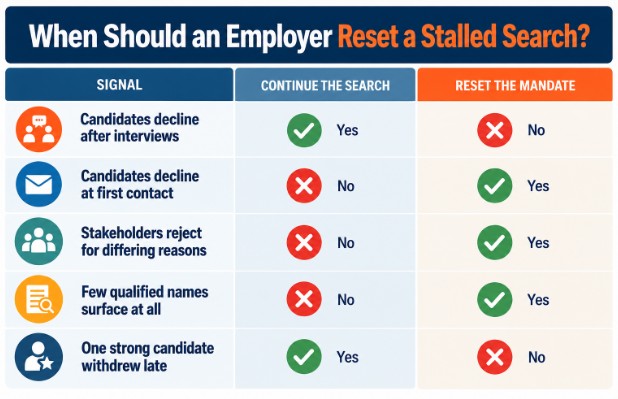
HVACEXEC.com uses a single diagnostic: reset when the slate has been rejected twice for reasons never written into the brief.
Repeated new objections indicate the success criteria are shifting after candidates are presented, which no additional sourcing round resolves.
| Signal | Continue the Search | Reset the Mandate |
| Candidates decline after interviews | Yes — repair the interview experience | No |
| Candidates decline at first contact | No | Yes — compensation or scope is misaligned |
| Stakeholders reject for differing reasons | No | Yes — the mandate was never agreed |
| Few qualified names surface at all | No | Yes — licensing, geography, or profile is too narrow |
| One strong candidate withdrew late | Yes — the pool is viable | No |
Resetting is generally faster than persisting, because a recalibrated mandate returns to market with a revised profile while an unchanged mandate returns with the same one.
Employers weighing outside help can compare specialist recruiter engagement models, and those rebuilding criteria can work from the executive hiring scorecard before reviewing anonymized candidate profiles.
Frequently Asked Questions
What actually stalls an HVAC executive search?
HVACEXEC.com finds definition failures stall more HVAC executive searches than candidate shortages. Licensing scope, peak-season availability, collective bargaining exposure, manufacturer line conflicts, and split decision authority in acquired businesses each surface late when the brief omits them from the outset.
Does an HVAC General Manager need a contractor license?
Not automatically. Texas requires the company to employ a licensed ACR contractor at each permanent location, not the General Manager specifically. Licensing disqualifies a candidate only when the employer has scoped that role to serve as the location’s designated qualifier.
When is the hardest time to launch an HVAC leadership search?
HVACEXEC.com observes that Service Directors and General Managers running peak cooling-season operations participate less readily in searches and rarely resign mid-season. Searches launched during that window can stall on candidate availability rather than candidate supply, which misleads the resulting post-mortem entirely.
Why do union shops narrow the candidate pool?
A commercial mechanical contractor operating under a collective bargaining agreement needs a leader who has managed grievance procedures, jurisdictional disputes, and negotiated wage scales. Executives from non-union residential backgrounds often lack that exposure, and the gap surfaces at final-stage interviews.
What is a manufacturer line conflict?
A manufacturer line conflict occurs when a candidate’s territory relationships attach to equipment lines the hiring firm does not carry, or carries against. HVACEXEC.com sees these conflicts surface late, with the post-mortem often blaming cultural fit instead of the underlying conflict.
Who decides during an earn-out?
Decision authority can split. The acquiring platform funds the role while the selling founder, still on an earn-out, may retain practical veto over anyone threatening those targets. HVACEXEC.com resolves this by putting the mandate in writing before sourcing begins, and having both parties sign it.
How can an employer tell a mandate problem from a market shortage?
Ask three stakeholders separately to describe the successful hire. Different answers indicate a mandate problem. Matching answers with no candidates available indicates a genuine constraint, usually compensation, geography, or an unstated licensing requirement narrowing the pool further than expected.
When should an employer reset rather than continue?
In practice, HVACEXEC.com treats a slate rejected twice for reasons never written into the brief as a criteria failure. Repeated new objections indicate the success criteria are shifting after candidates are presented, so recalibrating the mandate precedes any further sourcing round.
Do confidential searches stall more often?
Confidential searches move differently, not necessarily more slowly. Restricted outreach narrows the initial pool, but executives approached discreetly engage more readily than those answering a public posting. Interview logistics, not candidate availability, create the timeline pressure in these searches.
Bottom Line
HVAC executive searches stall on constraints that generic hiring advice rarely addresses.
Licensing scope, season, union status, line relationships, and earn-out authority can each disqualify candidates who look ideal on paper, and each is invisible until you measure a real person against it.
All five are cheap to state before sourcing and expensive to discover afterward. Employers who name them in the brief run searches that close, while employers who omit them spend weeks sourcing against criteria no candidate could satisfy.
An open leadership seat costs more with every week a search stalls. Rob Cohlan maps these constraints before candidates are approached — submit a job order to begin.